The drain camera inspection process usually matters most when a homeowner is tired of hearing possibilities. A drain backs up, gets cleared, then starts acting up again. A bad smell drifts in and out. Water slows down, then seems normal, then slips right back into the same pattern. By that point, most people are not looking for another guess. They want to know what is actually happening inside the line.
At EZ Flow Plumbing, we use a high-resolution waterproof camera to inspect the inside of drain and sewer lines in real time. The reason is simple. Hidden line problems rarely explain themselves from the outside. We would rather see the pipe clearly than make a repair plan around symptoms alone. Our video camera inspection service is built around that kind of accuracy.
Why the Drain Camera Inspection Process Starts Before the Camera Goes In
The drain camera inspection process does not really start with the camera. It starts with the pattern of the problem. We want to know which fixtures are affected, how often the issue comes back, whether more than one area of the house is involved, and whether the signs point toward a localized drain issue or something deeper in the sewer line.
At EZ Flow Plumbing, we treat that first part as real diagnostic work. On our plumbing diagnosis and inspection page, we explain that we use professional tools to identify what is causing the problem before it grows into something larger. That matters because a kitchen drain that keeps slowing down tells a different story than several fixtures backing up at once. One may point to buildup in a branch line. The other may point to trouble farther down the system.
That first conversation changes the feel of the whole visit. We are not showing up with a camera and hoping it gives us an answer. We are listening first, narrowing the problem down, and using the camera to confirm what the house has already been saying.
What the Drain Camera Inspection Process Looks Like Inside the Pipe
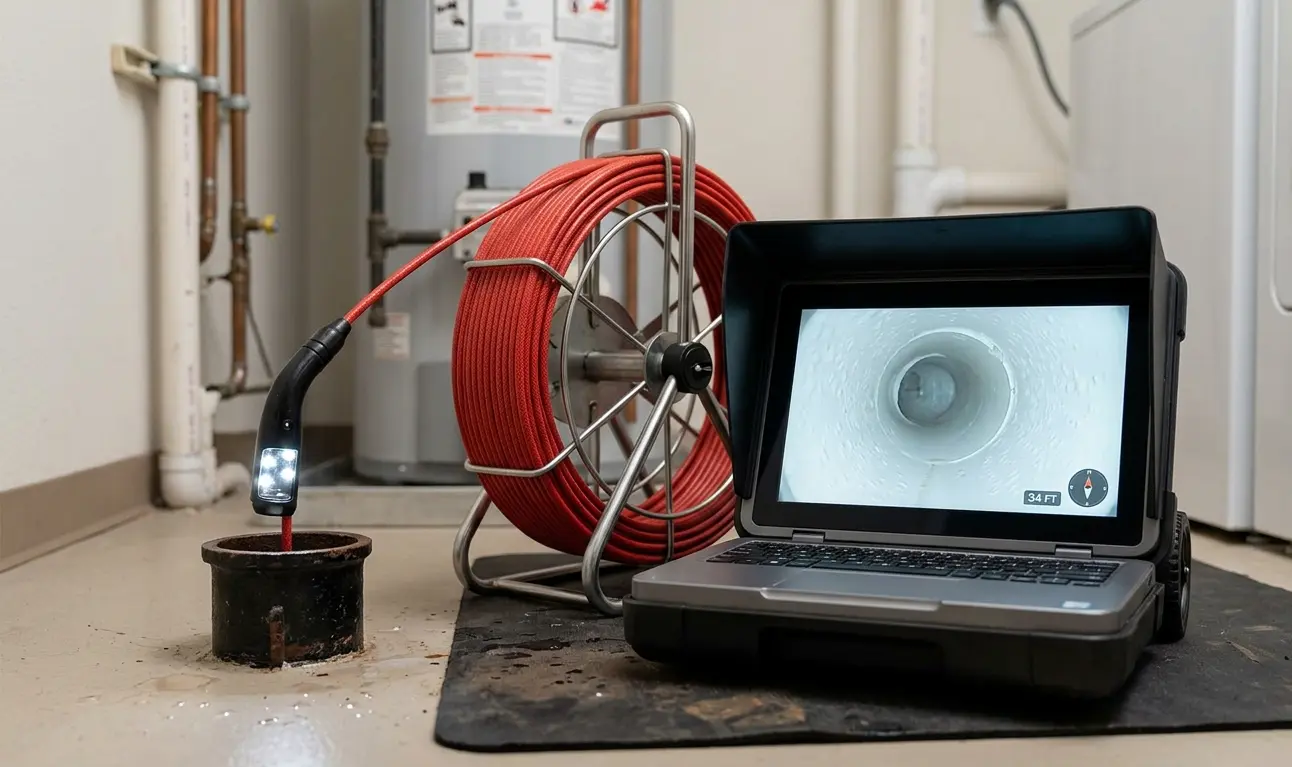
Once we choose the right access point, the camera work begins. We feed the camera into the line and watch the footage as it moves through the pipe. At EZ Flow Plumbing, we describe this as a non-invasive way to inspect hidden drain and sewer issues because it allows us to look inside the line without starting with destructive digging or unnecessary disruption.
For homeowners, this is usually the point where the problem stops feeling abstract. We are no longer describing what might be happening. We are seeing the condition of the pipe as it is. We can watch how the camera moves, where the line changes, where flow appears restricted, and where the interior stops looking healthy.
Professional inspection systems are designed for exactly that purpose. RIDGID describes sewer and drain video inspection equipment as a way to identify and locate issues inside the line. When locating tools are paired with the inspection equipment, the system can also help trace the line and pinpoint the section of pipe that matters most.
That second part matters more than most people expect. Knowing that something is wrong is helpful. Knowing where it is changes the repair plan.
What We Look For During a Sewer Camera Inspection
Most homeowners assume the camera is there to find a clog. Sometimes it is. A lot of the time, the picture is broader than that.
At EZ Flow Plumbing, we use camera inspections to look for stubborn blockages, fractures, corrosion, root intrusion, buildup, and other hidden line damage. A recurring drain problem can come from several different causes, and the footage helps us separate one kind of issue from another.
Grease buildup tells one story. Tree roots tell another. A cracked or shifted section of sewer line pushes the conversation in a different direction again. That is why a sewer camera inspection often gives people relief even when the finding is not ideal. Uncertainty is usually harder to carry than a clear answer. Once we can show what is inside the pipe, the next decision starts making more sense.
How the Drain Camera Inspection Process Changes the Repair Plan
The drain camera inspection process is not only about seeing inside a pipe. It is about choosing the right next step.
A lot of sewer and drain problems look similar from the outside. Slow drainage, recurring backups, odours, and gurgling can overlap. If we only react to the symptom, we risk treating the wrong thing or only half-solving the right thing. At EZ Flow Plumbing, we use camera inspection to remove that kind of guesswork. Our service page says the goal is to identify the problem accurately enough to repair only what is actually necessary.
That difference matters in a very practical way. If the camera shows buildup, cleaning may be the right answer. If it shows root intrusion, we need to explain why the problem keeps returning. If it shows structural damage, then repeated clearing is probably not going to solve the real issue for long. The footage gives us a clearer reason for every recommendation that comes after it.
When a Plumbing Camera Service Makes the Most Sense
Not every slow drain needs a camera right away. Some issues are simple and stay simple. Others keep coming back because the real problem sits deeper in the line.
A plumbing camera service makes the most sense when the trouble is recurring, when multiple drains seem affected, when sewer odours have no obvious source, or when a homeowner wants a stronger diagnosis before moving into bigger repair work. At EZ Flow Plumbing, we treat camera inspection as one of the smartest tools for that stage because hidden line problems rarely become clearer on their own.
That is part of the larger way we approach the work. On our About page, we explain that we use video inspection cameras and locating equipment to diagnose underground sewer and drain issues accurately. The point is not to make the job sound technical. The point is to make the repair make sense before we start it.
Why Homeowners Feel Better After the Inspection
Most plumbing stress comes from not knowing. People know something is wrong, but they do not know how wrong, where wrong, or whether the next repair will finally hold.
At EZ Flow Plumbing, we see that all the time. Once the camera shows the inside of the line, the pressure usually starts to drop. The homeowner does not have to imagine what may be happening underground anymore. We can explain what the footage shows, where the problem sits, and why the next recommendation fits the condition of the pipe.
That is the real value of the visit. The camera is the tool. The clarity is what changes the outcome. Once the inside of the line is visible, the repair stops feeling like a guess and starts feeling justified.
What the Process Really Gives You
The drain camera inspection process gives homeowners something they usually need long before the repair is finished. It gives them a reason to trust the next step.
Some problems turn out to be smaller than expected. Some are more involved. Either way, seeing the line clearly helps us make the right call sooner. It also helps the homeowner understand why the recommendation is what it is. We think that matters just as much as the camera itself.
At EZ Flow Plumbing, that is what we want this service to do. We want it to replace uncertainty with evidence, reduce wasted time, and make the work ahead feel clear enough to move forward with confidence.