Who repairs gas leaks is a question where the order of contact is as important as the contacts themselves. If you get the sequence wrong during an active gas event you can actually delay the response that will make the situation safe. The federal pipeline safety agency which is the regulator of the natural gas infrastructure in the US continually stresses that the public utility company is the first responder to a suspected gas leak and that the licensed plumber or gas line contractor is the one who carries out the repair work once the utility has confirmed the area is safe.
Who repairs gas leaks in a domestic situation is three parties: the gas utility, who are responsible for the supply line up to the meter, a licensed plumber or gas line contractor, who deal with the gas piping from the meter into the house, and in some cases both.
At EZ Flow Plumbing Texas we get a lot of gas line calls across Austin, Pflugerville, Round Rock, Georgetown and Hutto from people who aren’t quite sure who to call initially or who have already called the utility and been told it’s their side of the meter. We do the residential gas line diagnosis and repair and that’s the context in which the service makes sense.
The Immediate Response: What Comes Before Who Repairs Gas Leaks
Who repairs gas leaks is the right question after the immediate safety response is completed. During a suspected active gas event, the repair question is secondary to the sequence of steps that makes the environment safe first.
If a strong sulfur or rotten-egg smell is present, any hissing sound is audible near gas lines or appliances, or a gas detector has alarmed:
- Leave the building immediately without operating any electrical switches, using a phone inside, or attempting to locate the leak
- Leave the door open as you exit but do not prop it, do not go back inside
- Move away from the structure and call the gas utility from outside using a cell phone or a neighbor’s phone
- Do not re-enter the building until the utility has cleared the area as safe
- After the utility clears the area, contact a licensed gas line plumber for repair assessment
These steps are not optional or sequential based on how strong the smell seems. A licensed gas line plumber who repairs gas leaks is the correct contact for the repair that follows the utility’s clearance, not the contact during the active emergency itself. That sequence is what the utility, fire department, and gas safety authorities consistently instruct homeowners to follow.
Who Repairs Gas Leaks in a Licensed Context: The Credentials That Matter
Who repairs gas leaks on the residential side of the meter is a licensed plumber with gas line certification or a licensed gas piping contractor (again this will vary from state to state and local jurisdiction). In Texas the Texas State Board of Plumbing Examiners licenses and regulates gas line work under the Texas Plumbing License Law which covers the installation, repair and testing of gas piping systems in both the residential and commercial sectors.
Under Texas gas utility regulations, any gas piping work in a residential property has to be done by a licensed master plumber or a licensed journeyman plumber working under the supervision of a master plumber. An unlicensed individual doing gas line work is creating both a safety hazard and a liability for the homeowner as that work cannot be inspected or permitted by the city or county building department without the information of a licensed contractor attached to the permit.
A homeowner that calls in a general handyman, an appliance tech or an unlicensed contractor to do gas line work is not having the work done by someone who is legally licensed to repair gas leaks in Texas. The difference is important in terms of safety but also for insurance, future property sale disclosure and the city of Austin permitting and inspection process.
Common Scenarios and Who Handles Each One
Who repairs gas leaks varies by the specific situation a homeowner is facing. These are the most common gas leak scenarios in Austin homes and who the correct contact is for each.
| Scenario | First Contact | Who Repairs It |
| Strong gas smell inside the home | Gas utility emergency line, then evacuate | Licensed gas line plumber after utility clearance |
| Mild gas smell near a specific appliance | Licensed gas line plumber | Licensed gas line plumber |
| Gas smell near the meter or outdoor connection | Gas utility emergency line | Gas utility (their jurisdiction) |
| Dead vegetation over a gas line in the yard | Gas utility to locate and assess | Utility if main line, licensed plumber if service line after meter |
| Gas line damaged during renovation or digging | Utility emergency line, stop all work | Licensed gas line plumber after utility assessment |
| Suspected leak after a new appliance installation | Licensed gas line plumber | Licensed gas line plumber |
| Gas detector alarm without visible source | Follow active gas event protocol | Licensed gas line plumber after utility clearance |
| High gas bill without explanation | Licensed gas line plumber for pressure test | Licensed gas line plumber if active loss is confirmed |
What a Licensed Gas Line Plumber Does During the Repair Assessment
Who repairs gas leaks on the residential side is a licensed plumber, and understanding what that service visit involves helps a homeowner know what to expect and what questions to ask before the work begins.
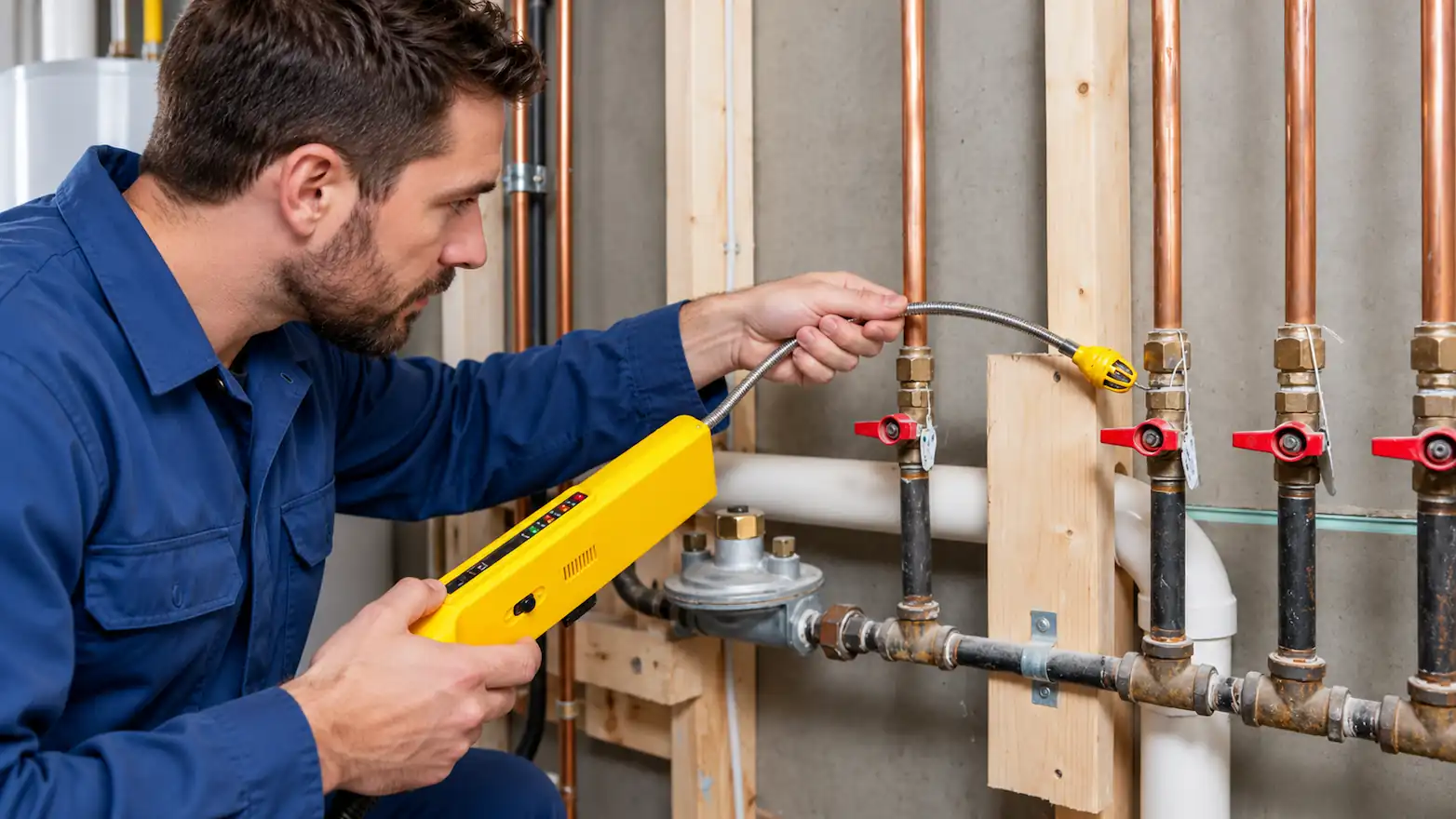
A gas line repair assessment begins with a pressure test of the residential gas system. The plumber will isolate the gas at the meter and pressurise the residential piping to a test pressure above normal operating pressure, monitoring for a pressure drop over a specified period. A pressure drop indicates that gas is leaking somewhere in the residential system. No pressure drop means there is no active supply side residential leak.
From there the plumber uses a calibrated gas detection to locate the exact point of loss. The meter will measure the concentration of gas in parts per million throughout the accessible areas of the gas system, thereby identifying the point or points of leak prior to any repair work being undertaken. That’s what makes the repair a targeted one rather than a guess.
Why Austin Gas Lines Require More Frequent Attention
Who repairs gas leaks in Austin is a question that comes up far more often in Austin than in many other places and the local circumstances explain why.
Austin’s natural gas infrastructure is replete with residential gas lines from the 1950s to the 1980s when black iron pipe and the early flexible connectors were the norm. The black iron pipe itself in good condition is quite durable, but the fittings and connections on the older installations do suffer from thread wear, corrosion at the exposed sections and joint separation as a result of the soil movement that affects all underground utility connections in Central Texas.
Austin’s expansive clay soil (which puts stress on all underground utility connections as it expands and contracts with the seasons) has the same effect on buried gas lines as it does on water and sewer lines. Our gas leak detection and gas line services page covers the full scope of what we assess and address for residential gas line conditions across Austin and Central Texas.
Choosing the Right Gas Line Plumber in Austin: What to Verify
Who repairs gas leaks is answered in part by credential verification, because not every plumber who offers gas line service is licensed for that specific work in Texas. A homeowner who verifies the following before committing to any gas line repair protects both the quality of the work and their own liability exposure.
Criteria to verify before hiring a gas line repair contractor in Austin:
- Active Texas Master Plumber or Journeyman Plumber license with gas line endorsement, verifiable through the Texas State Board of Plumbing Examiners website
- Current liability insurance and proof of coverage provided before work begins
- Confirmation that a permit will be pulled for any significant gas line repair, as required by the City of Austin
- Calibrated gas detection equipment used during the leak location phase, not sensory inspection alone
- A written pressure test result provided after the repair is complete, confirming the system holds pressure before the gas is restored
- Willingness to answer specific questions about the repair method and the materials being used
A contractor who meets all of those criteria is operating within the professional standard for who repairs gas leaks in residential Austin properties. One who cannot or will not provide those assurances is a contractor the homeowner should decline regardless of price.
After the Repair: What Confirms the Job Is Done Correctly
Who repairs gas leaks is as much about who leaves the documentation behind to prove the system is confirmed safe after the repair as it is about who actually turns up.
A properly completed gas line repair will involve a post repair pressure test at the test pressure required by the relevant code. That pressure test confirms that the original failure has been successfully sealed and that no other loss points have been created as a result of the repair. You simply can’t have a properly completed repair without that test result to prove the system is safe.
The permit and inspection process for gas line work in Austin requires a final inspection by a City of Austin building inspector to confirm that the work was done in accordance with code by a licensed contractor and that the system passes a pressure test at the time of inspection.
Getting a Gas Line Assessment That Leads to a Safe, Documented Result
Who repairs gas leaks in Austin? It’s a licensed gas line plumber who has the right equipment to detect the leak (calibrated), carries out a documented pressure test, has the requisite permits and provides you with a written record of the work and the post repair test result. That’s the standard you need to meet before any gas line repair is approved.
If you have confirmed a gas line issue after utility clearance or want a professional pressure test to confirm the system is sound, contact EZ Flow Plumbing Texas for a direct assessment and a documented result.