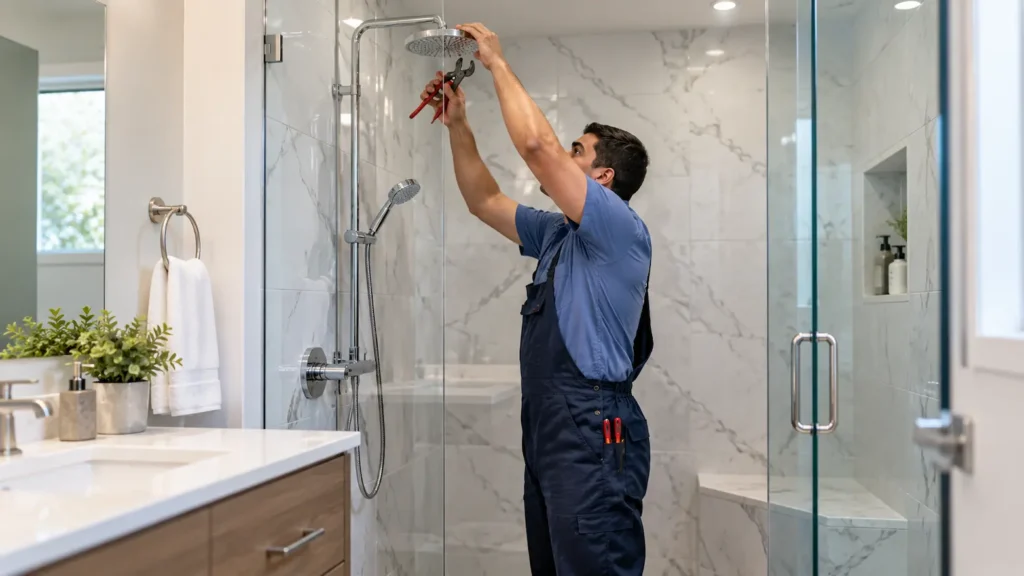
A water softener repair technician must either be a licensed plumber or a certified expert in water treatment; his or her duty is to detect and correct any faults that arise in a residential or lightly commercial water softening system, such as those involving the control valve, the resin tank, the brine tank, the regeneration cycle, the bypass valve, and all the related water supply connections.
It depends on where the problem is whether you should hire a water softener repair technician or a plumber; if the reason is a failed control valve, a malfunction of the regeneration programme, a clogged resin bed or a brine draw problem, then the case is one of repairing water treatment equipment and therefore calls for a knowledge of the particular system’s mechanics.
Before giving a quote or replacing any part, an EZ Flow Plumbing Texas water softener repair technician will first work out which component of the system is causing the symptom; the amount of work required is based on what the system shows rather than on any assumptions.
Why Water Softener Systems Require More Frequent Service in Austin
The Austin municipal water supply is one of the most difficult in the state. Due to the high levels of calcium and magnesium the water softener has to work much harder on a per gallon basis and as a result the interval between maintenance visits is shorter and there is accelerated wear on certain components (particularly the resin bed and the control valve).
The City of Austin Water Utility’s reported average water hardness is consistently above the level at which the water softening equipment manufacturers would recommend more frequent regeneration cycles. Therefore an Austin water treatment system which is programmed to regenerate in accordance with a schedule appropriate for water of average hardness will regenerate too infrequently when the actual hardness of the water is taken into account.
For the owner of a house in Austin whose water softener appears to be working OK but the water still tastes and feels hard when it comes out of the tap the issue is often not a failed softener at all but simply that the softener hasn’t been set to the correct hardness level for the local water.
Common Water Softener Failures and What Each One Requires
Water softener repair technician service calls in Austin cluster around a set of recognizable failure types, each with a specific location and resolution path.
| Failure Type | Probable Component | Typical Resolution |
| Hard water breaking through | Exhausted or fouled resin bed, incorrect regeneration settings | Resin cleaning or replacement, settings recalibration |
| System not regenerating | Control valve malfunction, programming error, power failure | Control valve repair or replacement, programming reset |
| Brine not drawing during regeneration | Injector clogged, brine line restricted, float assembly stuck | Injector cleaning, brine line flush, float adjustment |
| Salt bridge in brine tank | Humidity and temperature cycling causing salt to clump | Break up the bridge, clean the tank, adjust salt type |
| Water pressure drop through softener | Control valve restriction, resin fouled with iron | Valve service, resin cleaning or replacement |
| Leak at connections | Failed fitting, loose compression connection, aging bypass valve | Connection repair or replacement, bypass valve service |
| Error code on control head | Varies by manufacturer and code | Manufacturer-specific diagnostic, component replacement |
| Unusually frequent regeneration | Water hardness exceeds programmed capacity, sensor failure | Capacity recalculation, sensor inspection |
A salt bridge is one of the more common and least obvious failures for Austin homeowners to identify. The bridge forms when salt clumps together in the brine tank, creating a crust above the water level that prevents the salt below from dissolving into brine.
Water Softener Repair Technician vs. DIY: Where the Line Is
A water softener repair technician handles failures that go beyond what a homeowner can safely and effectively resolve without equipment, training, or access to manufacturer-specific parts. Understanding where that line is helps a homeowner avoid either calling for service on something they can address or attempting to fix something that will cost more to undo than it would have cost to call from the start.
These are situations a homeowner can typically address:
- Adding salt to the brine tank when the level is low
- Breaking up a visible salt bridge in the brine tank using a broom handle or similar tool
- Resetting the control head after a power outage by following the manufacturer’s programming guide
- Running a manual regeneration cycle when the water feels harder than usual after a period of high use
These require a water softener repair technician:
- A control valve that produces error codes that do not clear with a reset
- A resin bed that has been fouled with iron or that has physically degraded and needs replacement
- Any water supply connection that is leaking, regardless of how minor the drip appears
- A bypass valve that is stuck, leaking, or no longer moving to the correct position
- A system where regeneration appears to complete normally but water hardness at the tap remains unchanged
What a Water Softener Repair Technician Checks During the Diagnostic Visit
A water softener repair technician’s diagnosis goes beyond just the most obvious symptom; the sequence of assessment used to reach an accurate diagnosis proceeds in a logical order as it moves through the system rather than heading straight to the component which most frequently fails.
The assessment starts with testing the water hardness at two locations: at the raw water supply prior to the softener and at the treated water afterwards. The difference between these two readings shows whether the system is indeed softening and by how much, thus allowing a mechanical failure to be distinguished from one due to incorrect settings or insufficient capacity.
The technician then examines the brine tank to see the level of salt, whether there is a salt bridge, the level of the brine solution, and the proper functioning of the float assembly. He also checks the injector and the brine draw line to make sure there are no restrictions.
How Austin’s Hard Water Affects the Resin Bed Over Time
The resin bed forms the main part of a water softening system and, in Austin, has to work more per gallon than in almost any other city in Texas. It is made up of small beads which absorb sodium ions while giving up the calcium and magnesium ions contained in the water supplied. During each regeneration cycle the resin is flushed with brine, which causes the calcium and magnesium to be released and at the same time replenishes the beads with sodium so that the exchange process can go on.
In the high-hardness water situation in Austin the resin bed reaches saturation with hardness minerals more quickly per gallon of water treated than the figure given by the manufacturer for its standard capacity.
A water softener repair technician who, after a complete regeneration has been confirmed, finds that the hardness of the treated water is still breaking through is generally considering the possibility that the resin bed needs either a chemical cleaning using a resin cleaner or to be completely replaced, rather than making any changes to the control valve or the regeneration settings.
Our water softener installation and service page covers the full scope of what we assess and address for water softening systems across Austin and Central Texas
The Plumbing Connection: When the Softener Issue Is Not a Softener Issue
A water softener repair technician may discover that the issue the homeowner is having is not with the softener itself but rather with the way the softener is connected to the home’s plumbing system. Since this type of problem falls within the realm of plumbing repair and not water treatment equipment repair, a technician who holds a plumbing licence can deal with both matters during the same visit.
Typical problems on the plumbing side which influence the performance of a water softener are a bypass valve that has been fitted wrongly and as a result untreated water mixes with the softened water, supply connections which were made using incompatible fittings and which have been failing gradually since being installed, a drain pipe that was not properly secured and therefore drains into the incorrect place, and a regeneration drain connection that does not satisfy the local plumbing code requirements regarding backflow prevention.
When a water softener has been installed by the homeowner or by a person who is not licensed, a water softener repair technician will check the plumbing side for deficiencies since a system that has been installed incorrectly will still cause problems no matter how well the individual equipment components are working.
How to Choose Between Water Softener Repair and Full Replacement
Since the water softener repair technician is in a position to make an honest judgement as to whether a repair is a worthwhile investment considering the age and state of the present system, understanding the criteria on which that recommendation is based will enable the homeowner to assess it before making up their mind about taking either course.
If the softener isn’t working as it should and you would like an immediate evaluation before deciding on any course of action, then get in touch with EZ Flow Plumbing Texas to arrange for a plumber to visit your property in Austin and have the system looked at by a licensed professional who is familiar with both the water treatment and the plumbing aspects of a softener service call.