Commercial garbage disposal repair is the diagnosis and restoration of a food service disposal unit to full operational function, covering motor failures, impeller jams, drain connection restrictions, electrical faults, and damage to the grinding components. These are not residential problems with a commercial label. Commercial units operate under demand conditions that residential equipment is not built for.
The repair or replacement decision in a commercial context depends on the nature of the failure, the age of the unit, whether the horsepower rating still fits the kitchen’s actual throughput, and whether the failure is contained to one component or has spread across multiple parts of the system. A motor that seized from a single overload event in a two-year-old unit is a different situation from the same failure in a unit that has been running above its capacity for seven years in a high-volume kitchen without service.
We work with restaurant operators, kitchen managers, and commercial property owners across Austin, Pflugerville, Round Rock, Georgetown, and Hutto who need a complete picture before committing to a repair direction. At EZ Flow Plumbing Texas, commercial garbage disposal repair calls almost never arrive with a confirmed diagnosis.
Why Commercial Disposal Failures Are a Different Category From Residential Problems
Commercial garbage disposal repair addresses a failure profile that residential service does not encounter. A household disposal handles light food scraps and runs a few minutes per day. A commercial unit in an active kitchen processes shellfish shells, dense meat trim, fibrous vegetables, citrus rinds, and starchy waste across hours of continuous or near-continuous operation. The mechanical stress is not comparable, and the failure modes that result are specific to that operating environment.
Motor burnout and thermal overload are the most frequent triggers for commercial garbage disposal repair. Commercial disposal motors are rated for continuous duty, but they depend on adequate electrical supply, correct mounting, and reasonable material volume per cycle to operate within their thermal limits. A unit running on an undersized circuit, or one consistently pushed beyond its rated capacity, accumulates heat faster than the motor housing can dissipate it.
Impeller jamming is the second most common cause. Commercial kitchens introduce materials that would rarely reach a residential disposal: shellfish shells, meat bones, corn cobs, and compacting starches. When those materials enter the grinding chamber faster than the impeller can process them, or when a foreign object bypasses the drain cover, the impeller locks. If the overload protection engages in time, the motor survives the event.
Reading the Symptom Before the Plumber Arrives
Commercial garbage disposal repair needs vary based on what the unit is doing at the point of failure. Reading the symptom accurately before the service call reduces diagnostic time and gets the kitchen back online faster.
| Symptom | Most Likely Cause | Typical Repair Scope |
| Unit does not turn on | Tripped overload, blown circuit, electrical fault | Reset overload, verify power supply, inspect wiring |
| Unit hums but does not grind | Jammed impeller, seized motor shaft | Clear jam, test motor under load, replace if shaft is damaged |
| Unit grinds but drains slowly | Drain restriction, grease buildup between outlet and trap | Drain cleaning, outlet check, trap inspection |
| Unit leaks from the base | Failed internal seal, cracked lower housing | Seal replacement or full unit replacement |
| Unit vibrates excessively | Damaged impeller, loose mounting hardware | Impeller inspection, mounting check |
| Unit runs without processing waste | Worn impeller or shredder ring surfaces | Grinding component inspection and replacement |
| Unit trips the breaker repeatedly | Undersized circuit, motor drawing excessive current | Electrical assessment, motor inspection |
Each symptom points toward a different commercial garbage disposal repair path. A unit that hums without grinding may have a jammed impeller that clears in minutes, or it may have a seized shaft that requires full replacement. The inspection determines which. Treating those two scenarios as equivalent before opening the unit wastes time and produces the wrong recommendation.
The Drain System: Where the Problem Often Lives Beyond the Unit
Commercial garbage disposal repair that addresses only the unit body regularly fails to resolve the full operational problem because the drain system connected to the disposal is as likely to cause underperformance as the unit itself. A disposal that grinds correctly but drains slowly, or that backs up during peak service, is dealing with a drain restriction rather than a unit malfunction.
In commercial kitchen configurations, the drain line from the disposal connects to a grease trap or interceptor before joining the main sanitary drain. Grease, food solids, and detergent residue accumulate on the walls of that connection pipe over time, progressively narrowing the effective flow path. When that restriction reaches a threshold, the disposal appears to malfunction because drainage slows or stops, but the grinding mechanism itself is functioning correctly.
A commercial garbage disposal repair visit that includes inspection of the drain outlet, the trap connection, and the grease trap condition produces a complete system picture rather than a finding limited to the unit body. Austin and Central Texas commercial kitchens with heavy cooking volume frequently need the drain section between the disposal and the trap addressed in the same appointment rather than as a separate follow-up.
Repair or Replace: The Criteria That Actually Matter
Commercial garbage disposal repair is the right call under specific conditions. Replacement is right under different ones. Choosing incorrectly in either direction costs the business either unnecessary disruption from premature replacement or ongoing repair expense on a unit that has already exceeded its practical service life.
| Factor | Points Toward Repair | Points Toward Replacement |
| Unit age | Under 5 years, single isolated failure | Over 8 years, multiple service events in recent history |
| Failure type | One component, jammed impeller, single seal | Motor burnout, cracked housing, multiple simultaneous failures |
| Horsepower rating | Adequate for current kitchen throughput | Undersized for actual daily volume being processed |
| Repair cost vs. new unit | Under 40% of new installed unit cost | Over 50% of new installed unit cost |
| Operational history | First failure in an otherwise reliable unit | Repeated jams, frequent overload trips, declining output |
| Parts availability | Current model with available replacement components | Discontinued model, long lead times on specific parts |
A unit under five years old with a jammed impeller is a clear repair. A unit of nine years with a burned motor, a cracked housing, and two service events in the past eighteen months is a replacement. The ambiguous cases sit in the middle of that framework, and the inspection findings are what resolve them rather than the symptom presentation alone.
Downtime cost is a factor specific to commercial operations that sometimes changes the calculation. A commercial garbage disposal repair that restores full function the same day is preferable to replacement when the unit’s condition justifies it.
How the Diagnostic Works During a Licensed Service Visit
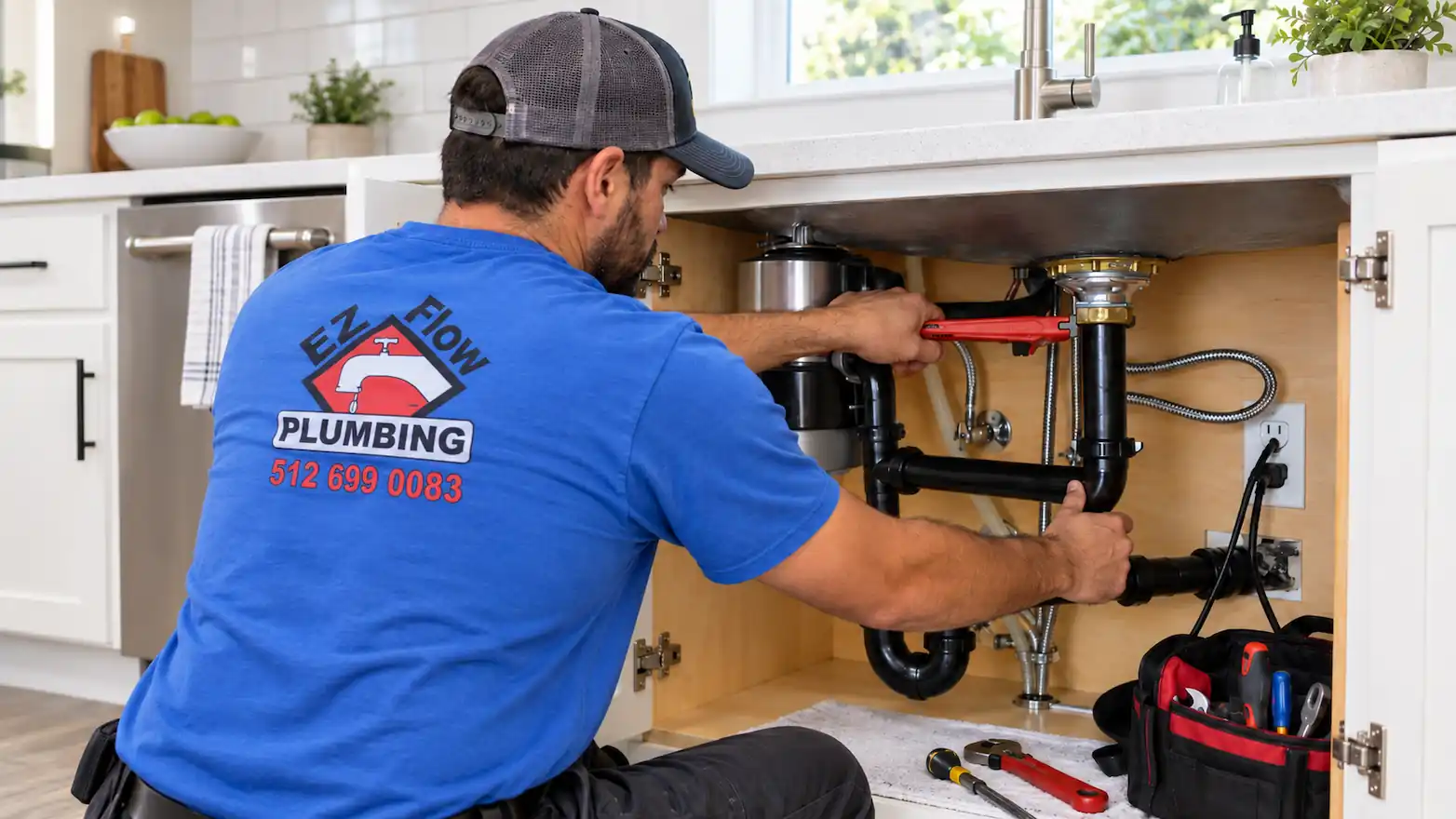
Commercial garbage disposal repair done correctly follows a sequence that covers the electrical supply, the unit body, and the drain connection before any recommendation is made. The order matters because each element in that chain can produce symptoms that resemble failures in a different part of the system, and skipping to the most visible component produces incomplete findings.
The inspection begins at the electrical supply. Confirming the circuit delivers adequate amperage for the unit’s rated draw, checking whether the overload reset has tripped, and verifying that the unit receives correct voltage at the connection comes first. A disposal that does not activate because of a tripped overload or an undersized circuit looks identical to one with a burned motor until the power supply is confirmed. Those are very different repairs, and the electrical check is what separates them.
From there the inspection covers the unit body: mounting integrity, motor function under load, impeller and shredder ring condition, internal seal integrity, and the drain outlet connection. A complete commercial garbage disposal repair diagnostic produces findings on all of those components rather than a single observation on the part that failed most visibly.
Grease Trap Condition and Its Direct Effect on Disposal Performance
Commercial garbage disposal repair in Austin-area commercial kitchens regularly involves the grease trap or interceptor as a contributing factor to the performance problems the kitchen is experiencing. The disposal drain feeds directly into the grease management system in most commercial configurations, and the condition of that downstream system has a measurable effect on how the disposal performs at peak service flow rates.
A grease trap that has not been pumped on schedule accumulates solids and grease to the point where it cannot accept the flow volume from the disposal during busy periods. The result is a backup that starts at the trap and moves upstream through the disposal drain line, eventually preventing drainage even when the disposal grinds correctly.
Austin’s Watershed Protection Department requires permitted grease traps and interceptors to be maintained on a pumping schedule that prevents overflow and sewer line impact. A commercial garbage disposal repair visit that identifies a full or overloaded grease trap as a contributing factor and includes that service in the same appointment resolves the complete problem rather than leaving part of it in place for the next service call.
Our commercial plumbing services page covers the full scope of what we assess and address for commercial kitchen plumbing across Austin and Central Texas, including disposal service, drain cleaning, grease trap coordination, and complete kitchen plumbing diagnostics.
What to Have Ready Before the Plumber Arrives
Commercial garbage disposal repair visits run faster and more efficiently when the kitchen manager or operator has prepared the relevant details before the plumber walks through the door. Preparation here means observation and access to the unit’s service history, not technical knowledge.
Information worth having ready:
- When the failure first appeared and whether it developed gradually or stopped suddenly
- What the unit was processing at or immediately before the failure occurred
- Whether pressing the overload reset button restores function temporarily
- The unit’s make, model, and horsepower rating from the nameplate on the body
- The date of the most recent service visit and what that service covered
- When the grease trap was last pumped and whether it is on a maintenance program
- Whether kitchen volume or menu composition changed around the time the problem started
Each of those details eliminates possible causes before the inspection begins, reducing the time the kitchen operates without its disposal during the service visit.
Getting the Right Commercial Service for Your Austin Property
Commercial garbage disposal repair affects how a kitchen operates, and the decision about how to address a failure should come from a complete assessment of the unit, the drain system, and the electrical supply rather than from an estimate formed before the diagnostic is done. A repair scope matched to the confirmed failure and the unit’s actual remaining service life produces a result that holds through the next year of service. One based on assumption produces the same call back in three months.
If your disposal is down or underperforming and you want a complete assessment before committing to a direction, contact EZ Flow Plumbing Texas to plan the right commercial service for your property and get the kitchen back to full operation.