The fact that water leaking from wall surfaces indicates that moisture is getting to the drywall, plaster, or finished material from a point located behind the wall, above it, or within the wall cavity. This moisture could be due to a pressurized supply line, a drain line that leaks occasionally while a fixture is in use, condensation on a cold pipe in a humid atmosphere, or water seeping in from the roof, a window, or some other exterior opening rather than as a result of a plumbing fault at all.
Since each of these possible sources calls for a different course of action, a homeowner who has identified the most likely source before contacting a service person will get the appropriate kind of assistance the first time.
The first thing that should be established is whether the source of the problem is a plumbing leak or some other kind of moisture ingress through a non-plumbing route. If a leak from the roof or windows is treated as though it were from a pipe, the plumber will be sent to the wrong section of the system, and if a leak in a pressurized water supply line is regarded as merely being condensation, active water damage will carry on within the wall cavity while no action is taken to deal with it.
At EZ Flow Plumbing Texas, almost all calls from homeowners in Austin, Pflugerville, Round Rock, Georgetown, and Hutto begin with the homeowner pointing out something they have noticed and then asking what it means.
The Four Most Common Sources of Water Leaking from Wall
Water seeping from the wall cavities can be traced to one of four source categories, and with each there is a distinct pattern of associated evidence which helps to identify the likely cause before a professional evaluation is carried out.
| Source Category | Typical Indicators | When It Appears | Urgency Level |
| Pressurized supply line | Continuous moisture, water meter registers with fixtures off, stain grows regardless of weather | Any time, does not correlate with weather | High, active continuous loss |
| Drain or drain connection | Moisture appears during or after fixture use, dries between use events | During shower, sink, toilet, or dishwasher use | Moderate to high |
| Roof or ceiling leak | Stain appears or worsens after rain, correlates with weather events | During or after rainfall or wind events | Moderate, depends on severity |
| Window or exterior penetration | Moisture at or near window frames, appears during rain or wind-driven rain | During or after specific weather conditions | Moderate, entry point needs sealing |
Water leaking from wall produces moisture that is present regardless of weather and regardless of whether any fixture is being used. A drain line leak produces moisture that appears during or shortly after a specific fixture is used and may dry out between use events. A roof or window leak correlates directly with rainfall or wind events and typically leaves the wall dry between weather events.
Drain Line Leaks Inside the Wall: The Intermittent Pattern and What It Means
Water leaking from wall which shows up during or after the use of a particular fixture and then dries out again between these occasions is in almost all cases due to a problem with the drain connection rather than a leak in the pressurized water supply. Since drain pipes only carry water when a fixture above them is being used, it is only during those times that a leak at the drain connection, a failed compression joint, a loose p-trap connection, or a worn section of pipe causes moisture to appear.
Within-wall drain leaks in houses in Austin are most often found at the point where the sink drain connects to the P-trap and this connection is not visible from inside the cabinet, at the drain connection at the back of a tub or a shower where the overflow plate is attached, at the toilet flange connection at floor level in bathrooms which have tile floors, and at the drain connections associated with the supply and drain fittings of the dishwasher or washing machine.
When Water Leaking from Wall Is Not a Plumbing Problem
The occurrence of water leaking from wall which corresponds directly and consistently with rainfall or wind events, especially on the external walls or below the roof line, indicates a failure of the building envelope rather than a plumbing problem. A qualified plumber examining a wall stain that is associated with weather conditions will probably not identify a pipe leak as the cause, and it would be a misguided first move to arrange plumbing services before excluding the building envelope as a source.
Failures in the roof flashing at places where the roof meets penetrations, skylights, or the wall allow water to get into the building envelope during periods of rain and then run along the roof structure before reaching the inner surface, often ending up a considerable distance from the actual point of entry.
If a moisture stain is found on an interior wall, with no plumbing in the vicinity and no exterior surface below the roof level that is exposed, yet the stain appears or gets worse after it has rained, the problem is almost certainly due to the roof or the flashing rather than a pipe.
Should the water leaking from wall evidence have a direct connection with weather events, the right first call should be made to a roofing contractor or a building envelope specialist, not to a plumber.
What a Professional Wall Leak Assessment Actually Covers
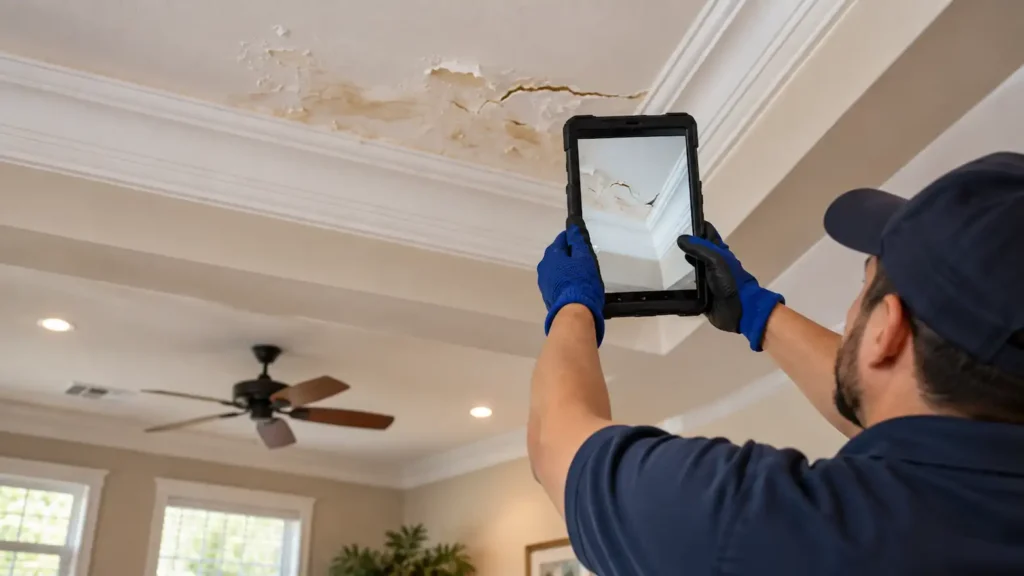
The process of carrying out a professional assessment of water leaking from wall begins with hearing the homeowner’s account of the symptoms before any equipment is used. The details that are gathered include where the moisture can be seen, when it first showed up, whether it occurs in connection with the use of fixtures or with weather events, the size of the area affected, and whether or not there is an odour connected with the moisture.
The water leaking from wall physical inspection includes the examination of all the plumbing that is accessible near the stain, such as the visible pipe connections under the sinks and behind any accessible panels, the connections of the water supply lines to the toilets and appliances, and any drain connections that do not require the wall to be opened.
A reading taken with a moisture meter at the surface of the affected wall shows how wet the material is and whether the moisture is concentrated at one point or spread over a broader area, thereby indicating whether the source is local or one that is coming from a distant location.
Austin-Specific Factors That Contribute to Within-Wall Pipe Leaks
Water leaking from wall in Austin and Central Texas homes occurs against a backdrop of local conditions that increase the probability of certain types of leaks relative to other regions.
Austin’s hard water supply, with its elevated calcium and magnesium concentrations, accelerates pitting corrosion in copper supply lines. Homes with original copper plumbing from the 1960s through the 1990s are in the age range where pitting corrosion breaches in supply lines are common in this water chemistry, and those pitting failures produce exactly the type of pressurized within-wall supply leak that produces a continuous moisture stain independent of fixture use and weather.
Austin’s temperature cycling, including summer periods where attic and wall cavity temperatures can exceed 120 degrees Fahrenheit followed by winter periods that occasionally produce freeze conditions, creates thermal stress on pipe connections within wall cavities. Our leaking pipes service page covers the full scope of what we assess and address for within-wall and hidden pipe leaks across Austin and Central Texas.
Getting the Right Assessment for What the Wall Is Showing
Water leaking from wall has a source that is identifiable with the right diagnostic approach, and the repair that follows is almost always more straightforward once the source is confirmed rather than assumed. The situations that produce repeated or failed repairs are almost always the result of addressing the most visible symptom without confirming where the water is actually coming from.
A homeowner who understands the four source categories, knows how to read the correlation between moisture appearance and fixture use or weather events, and can describe the symptom pattern accurately before the plumber arrives contributes directly to a faster and more accurate diagnosis. That accuracy is the difference between a service visit that resolves the problem and one that opens drywall in the wrong location while the actual source continues unaddressed.
If your wall is showing moisture and you want a direct answer on what is causing it before any work begins, contact EZ Flow Plumbing Texas to talk through what you are seeing and schedule the level of service the problem actually needs.