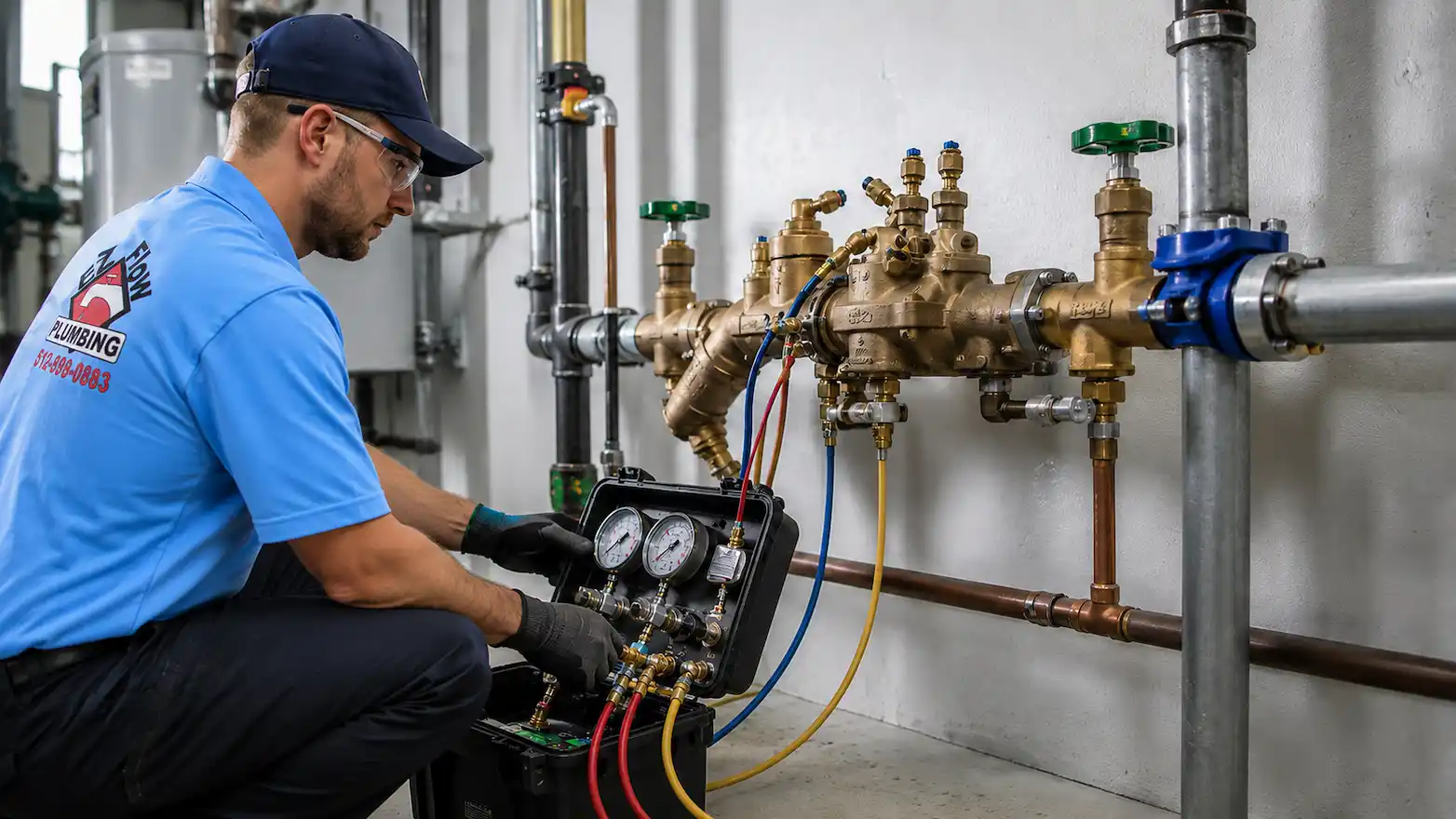
Backflow testing is the pressure-based verification of a backflow prevention assembly, confirming that its internal components stop contaminated water from reversing into the potable supply when pressure conditions change. The test does not rely on visual inspection. It uses a calibrated differential pressure gauge kit to measure whether each check valve, relief valve, and seating surface inside the device holds at the thresholds required by the local water authority.
A passing result documents that the assembly is functioning as designed. A failing result identifies which component has degraded and what the repair path looks like.
People who own property in Austin and Central Texas usually get a notice about backflow testing from Austin Water. This notice might come because they need to comply with some rules or because they are getting a commercial permit, or someone is reviewing their property management and they see something that needs attention. The notice will say what device needs to be tested, when it needs to be done by, and that a licensed tester has to send in the results.
The notice does not tell you what the test is actually checking for. It does not explain why the backflow preventers can stop working even if they look fine. It does not say what will happen if the test does not go well and what that means for what you have to do next with your property and the backflow testing.
At EZ Flow Plumbing Texas, we work with property managers, business operators, and homeowners across Austin, Pflugerville, Round Rock, Georgetown, and Hutto who need the test completed correctly and the documentation submitted on time. The goal is never just a passing form.
Why Water Flows Backward and What It Carries
Backflow occurs when pressure conditions in a water supply line drop below the pressure on the downstream side of a connection, causing water to move in the wrong direction. Two distinct conditions create this. Back siphonage happens when negative pressure in the supply line pulls water backward, the same mechanical principle as a drinking straw. Back pressure happens when downstream pressure exceeds supply pressure, which can occur in heating systems, elevated storage, or pressurized equipment connected to the water line.
Neither condition announces itself. Both can happen during a water main break nearby, a high-demand event on the municipal system, or during firefighting operations that draw pressure down rapidly. The reversal may last only seconds, but if the backflow preventer is not holding, that is enough time for downstream water to enter the potable supply.
What travels with the reversed water depends on what is connected downstream. Irrigation systems carry pesticides, fertilizers, and soil bacteria. Commercial kitchen lines carry grease, food particles, and cleaning chemicals. Boiler and chiller systems carry chemical treatment additives. Fire suppression systems carry stagnant water that may have been sitting for months. None of those substances belong in a drinking supply, and none of them are detectable by taste or appearance once diluted into the main.
The Three Main Types of Backflow Prevention Assemblies
The type of device installed on a property determines what the backflow testing procedure involves and what a failure result means for the repair. Three assemblies account for the majority of installations across Austin-area residential and commercial properties.
| Assembly Type | Protection Level | Common Applications | What Testing Checks |
| Pressure Vacuum Breaker (PVB) | Back siphonage only | Residential and light commercial irrigation | Check valve seat, air inlet opening under pressure drop |
| Double Check Valve Assembly (DCVA) | Back siphonage and back pressure | Fire suppression, commercial irrigation, low-hazard commercial | Each check valve independently at rated differential pressure |
| Reduced Pressure Zone Assembly (RPZ) | Back siphonage, back pressure, highest hazard | Boilers with chemical treatment, medical equipment, high-hazard commercial | Both check valves plus relief valve opening and seating behavior |
A pressure vacuum breaker is the standard device for residential irrigation in Austin. It protects against back siphonage but not back pressure, which makes it appropriate for connections where the downstream system carries only water at or below atmospheric pressure. Backflow testing confirms that the check valve seats correctly and the air inlet opens when supply pressure drops.
A double check valve assembly protects against both types of reversal and appears on fire sprinkler systems, commercial irrigation, and moderate-hazard industrial connections. It contains two independently operating check valves. Testing measures each valve separately against the required pressure differential.
What Backflow Testing Actually Measures
Backflow testing is not a visual check, and it is not a flow rate measurement. A licensed tester connects a calibrated differential pressure gauge kit to the test cocks built into the assembly, isolates each component in sequence, applies controlled pressure conditions, and reads whether each valve holds, opens, or leaks at the required threshold.
On a pressure vacuum breaker, the tester checks that the check valve holds a minimum of one pound per square inch of differential pressure and that the air inlet opens fully when supply pressure drops below the downstream side. On a double check valve assembly, each check valve is tested independently to hold a minimum differential of one pound per square inch. On a reduced pressure zone assembly, each check valve is tested, and the relief valve is confirmed to open at least two pounds per square inch below supply pressure.
The entire procedure on a functioning device takes between 20 and 45 minutes depending on the assembly type and how accessible the installation is. The tester records the gauge readings for each component, notes a pass or fail for each, and submits the completed form to the relevant water authority. A passing result closes the compliance cycle for that year. A failing result opens a repair window with a defined deadline.
Why Backflow Preventers Fail Even Without Visible Damage
The internal components of a backflow preventer are in constant contact with flowing water, debris, and the pressure differentials that come with normal system operation. Rubber seating discs harden over time as they lose elasticity, which prevents them from making full contact with the valve seat under reversal conditions.
Springs weaken with repeated compression cycles, reducing the closing force behind each check valve. Fine debris from the supply line collects on seating surfaces and creates a path for slow leakage that the device cannot seal around.
None of those failure modes are visible from the outside. A pressure vacuum breaker with a hardened disc and a weakened spring looks identical to a functioning one. The body is intact, the housing is dry, the shutoff valves move freely. The failure only appears when a calibrated test instrument applies the differential pressure that the device is supposed to resist.
This is why backflow testing cannot be replaced by a visual site check and why the annual schedule is not a bureaucratic formality. The mechanical degradation that causes failure is internal, progressive, and invisible until the test gauge shows it.
Common Failure Patterns and What They Mean for Repairs
The most frequent failure on a pressure vacuum breaker is a check valve that does not seat fully because a debris particle has lodged against the rubber disc or because the disc has hardened past the point of full surface contact. Cleaning the seat resolves debris fouling in many cases. A disc that has lost its shape or hardened through requires replacement of the check valve module.
On a double check valve assembly, the most common failure is a check valve that holds at low differential pressure but leaks when the pressure differential increases to the test threshold. That points to a seating surface that has worn, a disc that is no longer flat against the seat, or a spring that cannot close the valve with enough force under pressure. Repair involves replacing the internal kit for the affected check valve.
On a reduced pressure zone assembly, a relief valve that opens during normal forward flow is a failure condition that indicates the downstream check valve is not holding, allowing pressure in the zone between the checks to equalize upward and trigger the relief function. That requires identifying which check valve has failed and confirming that the relief valve seats correctly after the check valve is addressed.
In all three cases, the failure is not in the device body. It is in the internal components, which are designed to be serviceable. A licensed plumber who also holds a TCEQ tester certification can test, diagnose, and repair the device in a single visit and retest it before submitting the final documentation.
Repair or Replace After a Failed Backflow Test
The decision between repairing and replacing a failed assembly comes down to three factors: the nature of the failure, the age of the device, and whether the repair cost is proportionate to the remaining service life.
| Factor | Repair Makes Sense | Replacement Makes Sense |
| Failure type | Single component, debris fouling, worn disc or spring | Multiple failing components, corroded body, cracked housing |
| Device age | Under 8 years, first or second failure | 10 years or older, repeated failures |
| Repair cost | Internal kit cost is well below new assembly cost | Repair cost approaches or exceeds 50% of new unit cost |
| Body condition | Intact, no corrosion, shutoffs functioning | Body corrosion visible, relief valve housing compromised |
| Testing history | Regular annual tests on file | No testing history, unknown service record |
Most backflow testing assemblies have a reliable service life of 10 to 15 years with annual testing and maintenance. A device at 12 years with a second check valve failure in three years is sending a clear signal. The repair resolves the specific failure, but the underlying degradation continues. A new assembly installed correctly and tested from that point forward is the more defensible investment for a property that needs reliable cross-connection control.
What a Backflow Test Reveals About the Surrounding Plumbing
A backflow preventer does not sit in isolation. It connects to the main water supply on one side and to an irrigation line, fire suppression system, or commercial equipment connection on the other. The condition of those adjacent components affects how the preventer performs and how quickly it degrades after a repair.
When a licensed plumber performs backflow testing, the surrounding plumbing is accessible and visible. A shutoff valve upstream of the device that does not close fully affects the isolation required for accurate testing and points to a maintenance need on the supply line. A strainer clogged with debris from the municipal main indicates that particulate matter has been reaching the preventer and accelerating wear on its internal seats.
Moisture around the device body or on the downstream piping suggests a slow leak that predates the testing appointment.
None of those findings are the test’s primary purpose, but they are useful diagnostic information that a thorough plumber documents. Backflow testing treated as a standalone compliance task misses the opportunity to catch adjacent problems while the system is already isolated and under pressure. A plumbing diagnosis that takes in the full connection gives the property owner a more complete picture of system health, not just a pass or fail result on a single device.
Getting Backflow Testing Done Right the First Time
Backflow testing is a manageable annual appointment when the device has a documented testing history, the property owner knows what assembly is installed, and the plumber arriving is licensed to test and qualified to repair whatever the results reveal. It becomes more complicated when the device has never been tested, when testing records did not transfer with the property, or when a failed result arrives alongside a 30-day compliance deadline and no repair plan in place.
The most efficient path is a single licensed professional who handles the test, identifies any failure, performs the plumbing repair, and retests before submitting documentation. That eliminates the coordination gap between tester and plumber, keeps the timeline predictable, and gives the property owner one point of contact for everything the test uncovers.
If your property has a backflow testing notice outstanding, a deadline approaching, or a device that has not been tested in several years, the right move is a direct conversation with a plumber who can assess the full situation. Contact EZ Flow Plumbing Texas to schedule your backflow testing appointment and get a clear answer on what your system needs before the deadline moves.